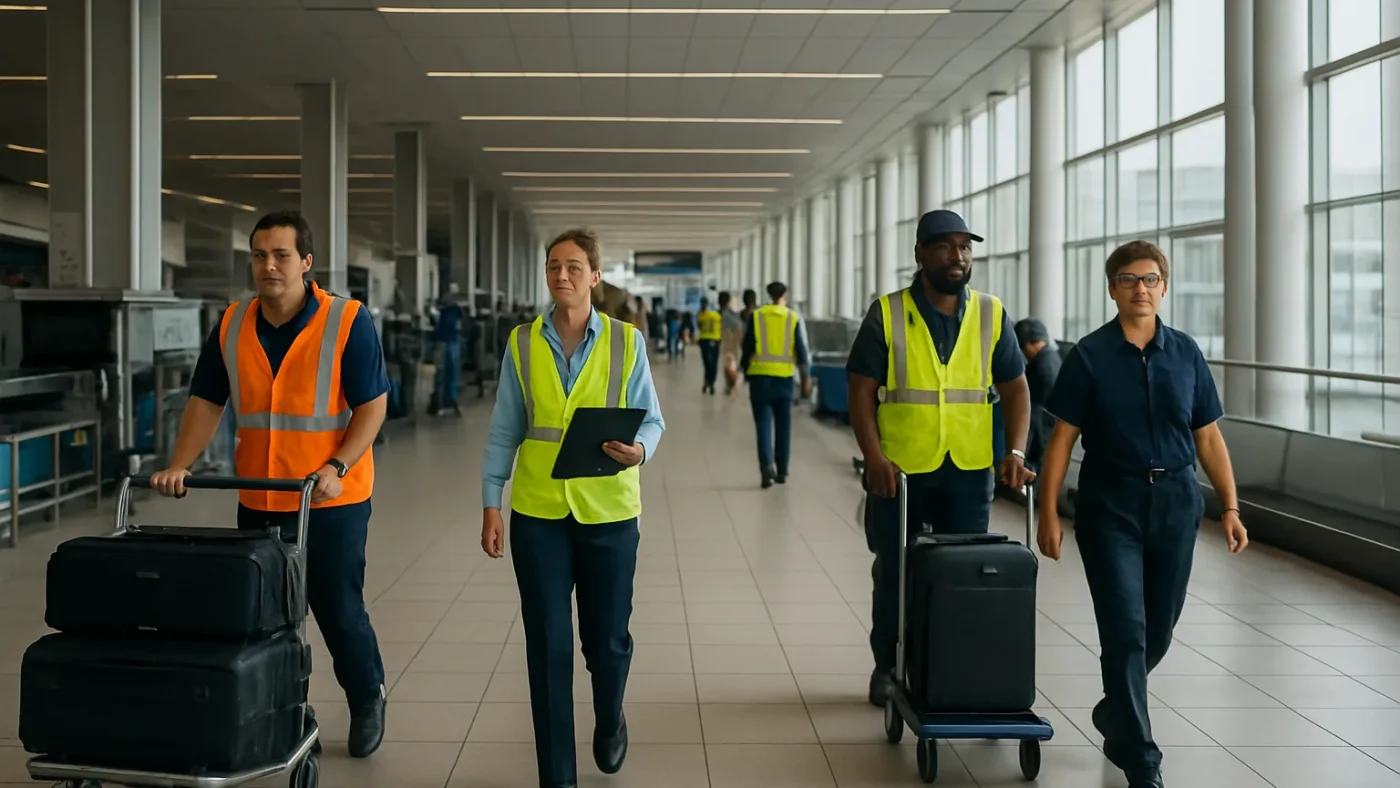
If you are looking for airport jobs, you do not need to be a pilot or flight attendant to find possible paths. An airport is more like a small city than a single workplace. Airlines are only part of it. Airports also bring together public agencies, restaurants, stores, cleaning companies, baggage and cargo contractors, parking operators, rental-car businesses, hotels, and other employers.
That setup creates a wide range of roles, including jobs that may be accessible without a college degree. The key is knowing which employer actually owns the job and understanding that an airport badge or security screening can add steps after you apply. Here is how airport employment generally works and how to search for legitimate opportunities.
An airport is a workplace with many employers
A common mistake is searching only one airline’s careers page and assuming that is the full list of airport work. Airlines hire for their own operations, but many people working inside a terminal, on a ramp, or near airport property work for a different company.
The airport authority, city, county, or other public entity that operates the airport may employ maintenance workers, administrative staff, operations personnel, tradespeople, parking staff, customer-service employees, and facilities teams. Those positions are often listed through a government or airport employment portal rather than an airline site.
Airlines may post jobs such as gate agent, ticket counter representative, baggage service worker, cabin cleaner, customer-service representative, cargo employee, or operations-related support staff. Requirements vary by role, location, schedule, and the airline’s policies.
Then there are the businesses that support airline and airport operations. A ground-handling company may handle baggage, aircraft cleaning, wheelchair assistance, fueling support, cargo, or ramp services. A concession operator may hire workers for food counters, restaurants, bars, coffee shops, newsstands, and retail stores. A separate employer may run parking shuttles, rental-car counters, security services, janitorial work, or hotel operations nearby.
In other words, two people working side by side at an airport may have entirely different employers, schedules, benefits, application systems, and onboarding rules.
Common airport jobs beyond flight crews
Airport work includes public-facing jobs, physical operations jobs, office roles, and skilled positions. Openings change, so use job titles as search ideas rather than assuming any particular role is available.
Terminal and customer-service roles
These jobs are a fit for people who are comfortable helping the public, explaining procedures, handling changing situations, and working around travel schedules. Common titles can include:
- Customer-service representative
- Passenger service agent
- Gate or ticket counter agent
- Wheelchair assistance attendant
- Airport information representative
- Rental-car service representative
- Parking attendant or shuttle driver
- Restaurant, retail, and food-service worker
Many of these roles involve standing for long periods, working early mornings or evenings, and interacting with stressed or rushed travelers. Strong communication, reliability, basic computer comfort, and a calm approach to customer problems can matter as much as direct airport experience.
Baggage, cargo, and ramp work
Behind the scenes, airports need employees to move luggage and goods, clean aircraft, load supplies, maintain equipment, and help keep operations organized. Possible titles include baggage handler, ramp agent, cargo warehouse worker, cabin cleaner, utility worker, equipment operator, and fleet or facilities maintenance worker.
These jobs can be physically demanding. A posting may describe lifting, outdoor work, noise, weather exposure, shift work, safety procedures, or the need to drive on airport property. Read the physical requirements carefully before applying. If warehouse work interests you, this guide to finding warehouse jobs near you and understanding the requirements can also help you compare common expectations.
Office, technical, and skilled-trade positions
Larger airports and their vendors may also need dispatchers, scheduling coordinators, payroll staff, IT support, mechanics, electricians, custodians, building engineers, construction workers, and administrative assistants. Some jobs require licenses, certifications, prior experience, or specialized training. Others may be entry-level but still require a dependable work history and the ability to complete airport access procedures.
Who should you apply through?
Start by identifying the employer listed on the posting. Do not assume the airport itself is the hiring organization just because the job location is an airport terminal.
- For airport authority jobs: Check the official airport or local government employment page.
- For airline jobs: Search the airline’s official careers site using the airport code, city, or nearby metro area.
- For restaurants and stores: Look for the concession brand, restaurant group, or retailer named in the listing.
- For ramp, baggage, cargo, cleaning, and passenger assistance: Look for the contractor or ground-services company identified in the posting.
- For federal or public-safety roles: Use the relevant agency’s official employment site and carefully review eligibility requirements.
Search engines and job boards can help you discover employers, but apply through an official career site whenever possible. Be cautious if a listing asks for payment, requests sensitive information before a real application process, or directs you to communicate only through a personal email address. For broader search habits, see how to find legitimate job openings near you.
How airport badging and screening generally work
Many airport jobs require access to areas that the public cannot enter, such as secure terminal zones, ramps, baggage areas, cargo facilities, or restricted office spaces. For those roles, a worker may need an airport-issued identification badge after receiving a job offer or conditional offer. The exact process depends on the airport, the employer, the job duties, and the type of access needed.
Badging is not the same thing as going through passenger security before a flight. It is an employment access process designed to determine whether a worker can receive credentials for a particular airport area. Your employer and the airport’s badging office typically provide instructions if the role requires it.
The process may involve identity documents, a background review, fingerprinting, security training, a photo ID badge, and an explanation of rules for entering restricted areas. Some employers may also have their own pre-employment steps, such as verifying work history, checking driving eligibility for driving roles, or requiring a drug screening where permitted and relevant to the job. Never assume every airport job has the same requirements; the official posting and employer instructions control.
Be accurate on your application. Dates, prior employers, addresses, legal names, and identification documents may be reviewed closely during onboarding. If you have a concern about a past issue or a gap in work history, do not guess about your eligibility. Ask the employer’s recruiter or hiring contact what documentation is needed and whether the role has specific restrictions.
What can make an airport application stronger
Airport employers often need people who can show up consistently for shifts that may begin before normal business hours or end late at night. Your resume should make practical strengths easy to spot: customer service, cash handling, driving, safety awareness, equipment use, cleaning, food service, inventory, scheduling, computer systems, teamwork, and attendance.
If you have little work experience, include volunteer work, school activities, caregiving responsibilities, certifications, or temporary work that demonstrates reliability. This guide on getting hired with little or no work experience offers ways to present those strengths honestly. You can also use this advice on writing a resume for entry-level jobs to tailor your application to the role.
Before an interview, prepare for practical questions: Can you work the required shifts? How would you handle an upset customer? Are you comfortable with the physical duties? How have you followed safety procedures before? Give short, truthful examples from past work or everyday responsibilities.
Check transportation before you commit
Airport locations can be difficult to reach, especially during overnight, early-morning, or late-evening shifts when public transit may be limited. Check the actual work location, parking rules, bus or rail schedules, and how long security entry may take before accepting an offer. A job inside a terminal, at a cargo facility, and at an off-airport rental-car site may all have different commute needs.
If a role requires driving, review the posting for license, driving-record, and vehicle-related expectations. Do not assume that having a driver’s license automatically qualifies you for an airport driving role.
A practical next step
Make a short list of airports within a commute you can realistically manage. For each one, check the official airport employment page, major airlines that serve the location, and the employers named on restaurant, parking, rental-car, and ground-services listings. Search by job type as well as by “airport jobs,” then compare the employer, schedule, location, physical duties, and badging requirements before applying.
That approach gives you a more complete picture than looking only for cabin crew positions—and helps you focus on airport work that fits your skills and daily life.